Keyword:
Energy Trading Platform
Ancillary Service Products
The introduction of Ancillary Service Products includes three parts: Introduction, Specifications, and Type of Resources.
1 Introduction
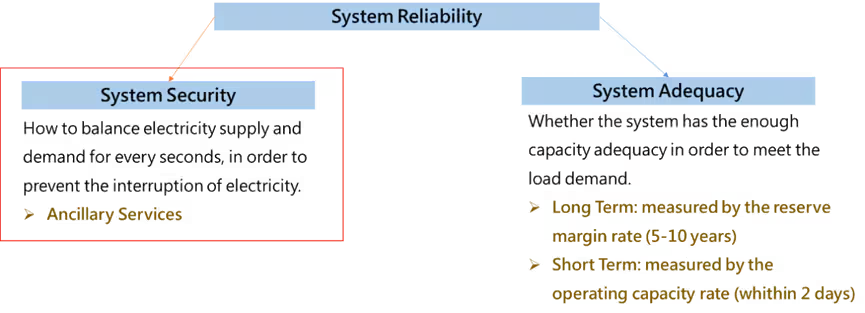
Ancillary Services are a series of services required to maintain the safe and stable operation of the power system or to restore the system to a normal state after an accident. In terms of power system reliability, ancillary services belong to the category of system quality and safety, as shown below:
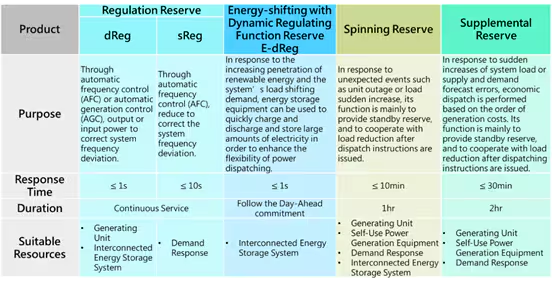
The trading products of Day-Ahead Ancillary Service Market include Regulation Reserve, Energy-shifting with Dynamic Regulating Function Reserve, Spinning Reserve, and Supplemental Reserve. As shown belows:
(courtesy of Taiwan Power Company)
2. Specifications
Resources which are qualified to participate in the day-ahead ancillary service market, must have the qualified capacity more than 1MW, and should pass the resource ability test to meet the technical requirements.
The requirements corresponding to regulation reserve, energy-shifting with dynamic regulating function reserve, spinning reserve, and supplemental reserve are respectively different. Among them, the specifications of the regulation reserve are divided into "dReg" and "sReg". The technical requirments of each trading products are as follows:
1. Regulation Reserve (dReg)
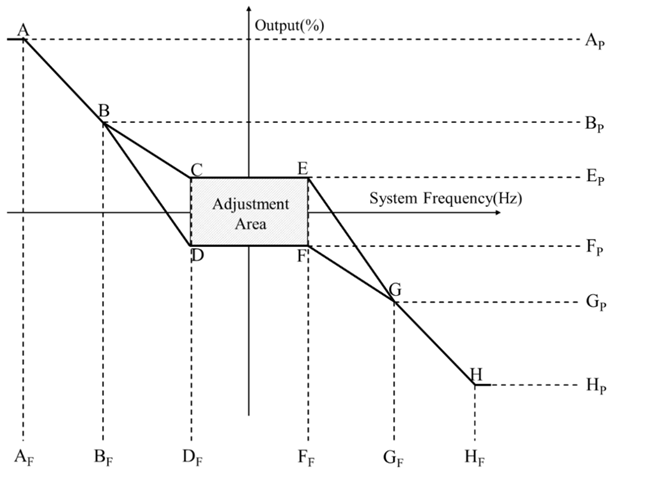
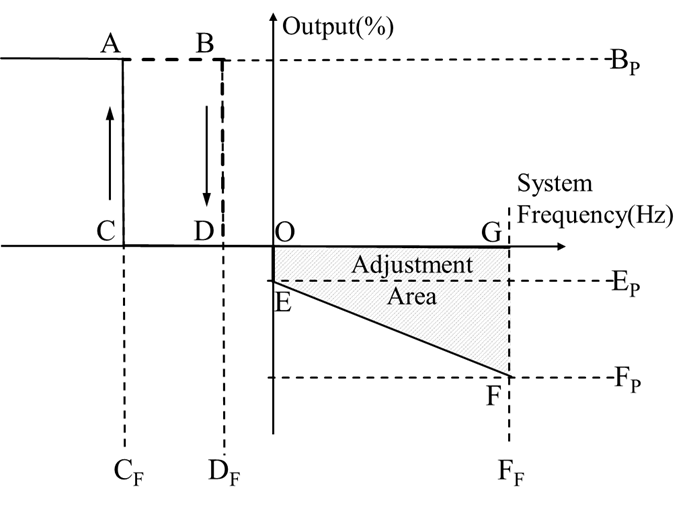
sReg is a static one-sided upward response frequency modulation service. When the system frequency drops to the specified frequency, trading resources should start output within a few seconds and reach 100% bid capacity within 10 seconds to help the system frequency quickly return to Within the normal range, avoid the system frequency from continuing to drop. sReg follows the system frequency variation output/input power curve with 60Hz as the reference value, as shown below.

(courtesy of Taiwan Power Company)
2. Regulation Reserve(sReg)
Automatically detect the system frequency and automatically adjust the corresponding output by following Operating Curve. Don’t need to receive the dispatch instruction from the dispatch center, and should be able to fully respond in 10 seconds. The detailed Operating Curve of sReg are as follows:

(courtesy of Taiwan Power Company)
3. Energy-shifting with Dynamic Regulating Function Reserve (E-dReg)
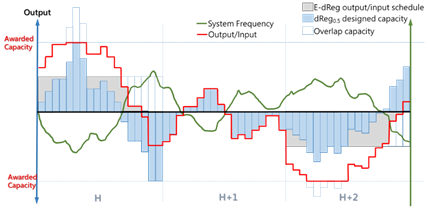
E-dReg should perform charging or discharging for a specified length of time based on a given schedule or dispatching instruction; and should have an automatic frequency control function to provide upward and downward adjustment services that continuously follow the system frequency every second.
For a single resource participating in E-dReg, the amount of energy stored in the resource should be at least 2.5 times the transaction capacity, and the transaction capacity and energy storage capacity should not be less than 1MW and 2.5MWh respectively.
4. Spinning Reserve
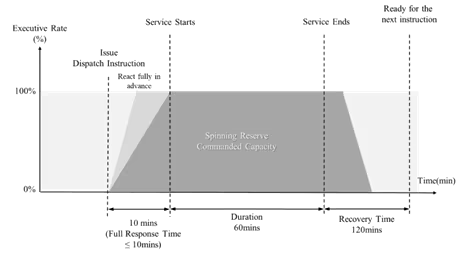
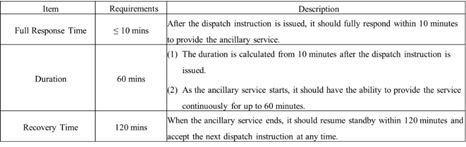
It should reach 100% of the commanded capacity within 10 minutes after receiving a dispatch instruction. Then, the service should maintain 60 minutes and will resume on standby 120 minutes after the end of the service.
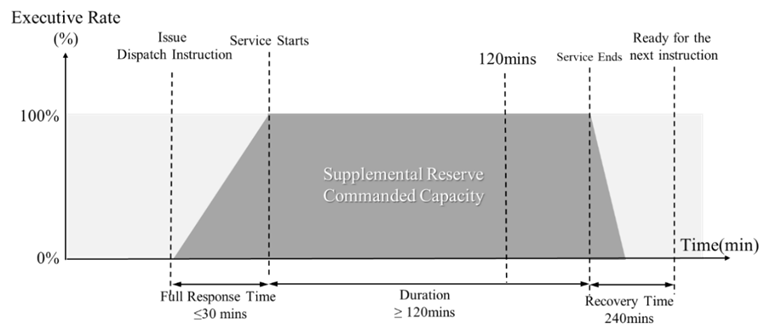
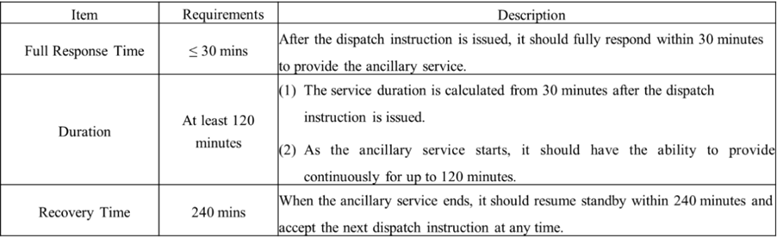
5. Supplemental Reserve
It should reach 100% of the commanded capacity within 30 minutes after receiving a dispatch instruction. Then, the service should maintain 120 minutes and will resume on standby 240 minutes after the end of the service.
3 Type of Resources
Types of resources refer to the identity of the equipment of the ancillary services provider that can participate in the day-ahead ancillary service market. There are 4 types of the resource: generating unit, self-use power generation equipment, demand response, and interconnected energy storage system. Following are the introduction to each type of resources:
1. Generating Unit
Participate directly as a power generation industry. 。The participating capacity is limited to the capacity that has not signed a power purchase and sale contract (PPA/FIT) with the public power sales industry. 。The transaction information recorded by M is calculated in the transaction table.
2. Self-Use Power Generation Equipment
Participate directly as self-use power generation equipment.
Ancillary service participation capacity is subject to actual execution capability testing.
-Instant transfer: limited by the capacity to add additional data within 10 minutes.
-Supplementary transfer: limited to the capacity that can be added within 30 minutes.
Additional transaction meters should be installed in front of self-use power generation equipment.
The calculation basis is based on the instantaneous capacity of the latest telemetry communication data returned before the immediate backup capacity or supplementary backup capacity execution command is issued, and the unit is kW or MW.
3. Demand Response
Participate directly as a demand response provider.
The participating capacity should be limited to the capacity of the regular contract signed with the public electricity sales industry.
Those who participate in the "Demand Response Load Management Measures" or other program measures of the public electricity sales industry, except those who are expressly prohibited from participating in the power trading platform, can apply to participate.
If there is a reverse transmission behavior with the approval of Taipower Corporation, and the demand response is achieved through multiple power resources behind the meter, in principle, a separate transaction meter should be installed in front of the reversible power resources.
4. Interconnected Energy Storage System